PrAACticamente Conectados: Una Experiencia Chilena Para Ampliar las Voces en la Escuela
Happy first Friday, AAC friends! On the first Friday of each month, we publish a post in Spanish by guest author Claudia Marimón to highlight AAC work being done in Spanish-speaking countries and offer translations of material that can help families and service providers. In this month’s post, Claudia introduces us to a project promoting more inclusive communication at a high school in Chile.
Enjoy!
:::::::::::::::::::::::::::::::::::::::::::::::::::::::::::::::::::::::::::::::::::::::::::::::::::::::::
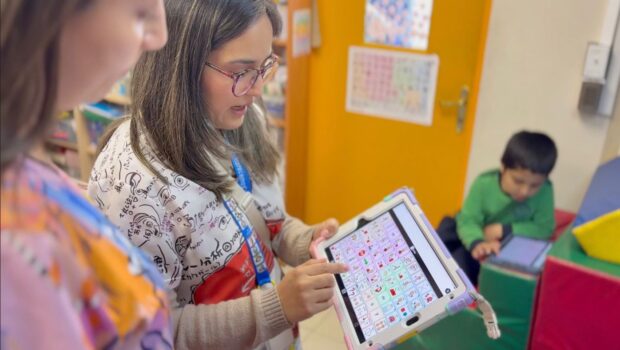
Comenzando el mes de noviembre quiero compartir la experiencia y la propuesta innovadora en la que tuve la oportunidad de participar. Que puede ser muy interesante no solo para la comunidad hispanohablante sino para todos aquellos que valoran la comunicación en todos los entornos naturales. En la escuela, todos podemos aportar a lograr un entorno comunicativamente accesible.
Comunicación Inclusiva con Proloquo2Go: una experiencia chilena para ampliar las voces en la escuela
“¿Qué hiciste hoy en clases?”
La pregunta parece simple, pero para muchos estudiantes con desafíos comunicativos, responderla puede ser una tarea monumental.
En Chile, Fundación El Clan desarrolló el proyecto “Comunicación Inclusiva con Proloquo2Go” en el Liceo Bicentenario Amanda Labarca de Vitacura, promoviendo la comunicación como un derecho mediante el uso de tecnologías de Comunicación Aumentativa y Alternativa (CAA), la formación docente y el trabajo colaborativo con familias y equipos escolares.
Cinco áreas que dieron voz a la inclusión
El modelo de intervención se organizó en cinco áreas interconectadas, que permitieron llevar la comunicación aumentativa al corazón de la vida escolar.
1. Tecnología
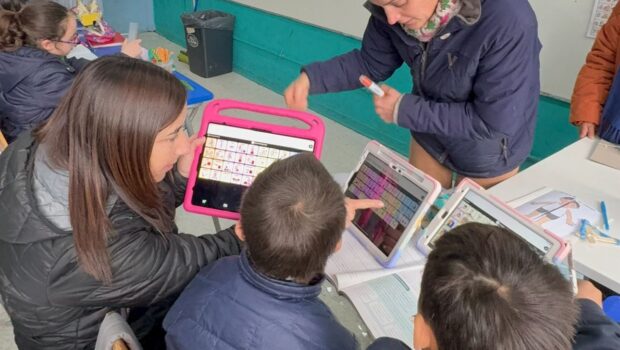
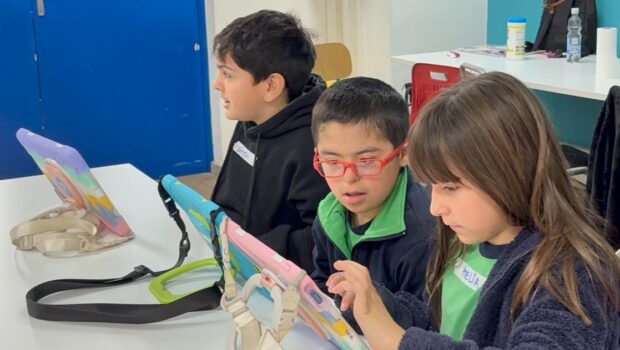
Cada estudiante con desafíos en la comunicación recibió un iPad con la aplicación Proloquo2Go, y también se entregaron dispositivos al equipo PIE para acompañar y modelar su uso en las actividades diarias.
Más que una herramienta digital, el comunicador se convirtió en una puerta a la participación y la expresión autónoma.
2. Sensibilización: sala inclusiva y compañeros de comunicación
La sensibilización alcanzó a más de 1.500 personas, entre estudiantes, familias y docentes. Con el cuento “La voz de Mía” como punto de partida, se promovió la empatía y el respeto por las distintas maneras de expresarse.
Surgieron así los “compañeros de comunicación”, estudiantes que aprendieron a acompañar a quienes usan comunicadores, haciendo de la sala un lugar más inclusivo y colaborativo. Adicionalmente, se reforzó el trabajo con tableros de baja tecnología distribuidos en distintos espacios del colegio.
3. Capacitación a docentes y asistentes
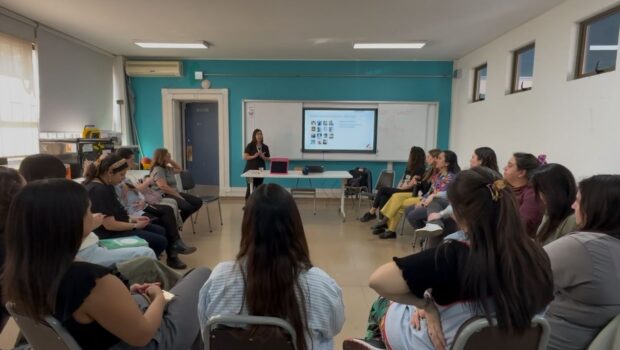
Se capacitó a más de 130 docentes, asistentes y profesionales PIE mediante cinco talleres presenciales, enfocados en los principios de la Comunicación Aumentativa y Alternativa, estrategias de modelado y uso del lenguaje núcleo, e integración del comunicador en las rutinas pedagógicas.
4. Terapias individuales
Paralelamente, se desarrollaron más de 45 sesiones terapéuticas individuales y grupales con los estudiantes.
Las sesiones buscaron modelar el uso del comunicador, fortalecer la intención comunicativa y vincular el trabajo escolar con la familia.
5. Evaluación
Desde una línea base inicial, la evaluación del proyecto avanza mediante focus groups, observaciones y entrevistas, orientadas a medir su impacto en la comunidad escolar, los cambios en el entorno educativo y la incorporación sostenida de la CAA en la práctica pedagógica.
Más que palabras: una cultura de escucha
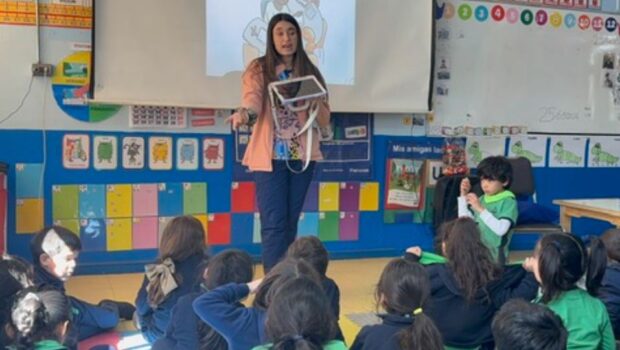
El proyecto nos recordó que la comunicación no solo se enseña, se construye juntos: en cada gesto, en cada espera, en cada mirada que dice “te entiendo”. Hoy sabemos que cuando un niño encuentra su voz, toda la comunidad aprende a escuchar, y la inclusión deja de ser un ideal para convertirse en una realidad.
Mirando hacia el futuro
“Comunicación Inclusiva” mostró que la verdadera inclusión nace de la convicción de que todas las voces deben ser escuchadas.
El desafío ahora es expandir esta experiencia, acompañar a más familias y fortalecer comunidades que valoren la diversidad comunicativa.
Sobre Fundación El Clan
Fundación El Clan promueve la inclusión educativa y la comunicación en niños y jóvenes con neurodiversidad, combinando tecnología, formación y trabajo con familias para que todas las formas de comunicarse sean valoradas.
Starting November I want to share the experience and the innovative proposal in which I had the opportunity to participate. Which can be very interesting not only for the Spanish-speaking community but for all those who value communication in all natural environments. At school, we can all contribute to achieving a communicatively accessible environment.
Inclusive Communication with Proloquo2Go: A Chilean Experience to Amplify Voices in Schools
“What did you do at school today?”
The question sounds simple, yet for many students with communication challenges, answering it can be monumental.
In Chile, Fundación El Clan set out to transform that everyday silence into an opportunity through the project “Inclusive Communication with Proloquo2Go”, implemented at the Amanda Labarca Bicentennial High School in Vitacura. The initiative promotes communication as a human right and a tool for participation, combining Augmentative and Alternative Communication (AAC) technologies, teacher training, and close collaboration with families and school teams.
Five Areas that Gave Voice to Inclusion
The intervention model was structured around five interconnected areas, bringing AAC to the center of school life.
1. Technology
Each student with communication challenges received an iPad equipped with the Proloquo2Go app, and additional devices were provided to the Special Education (PIE) team to support and model AAC use during classroom activities.
More than just a digital tool, the communicator became a gateway to participation and autonomous expression.
2. Awareness: Inclusive Classrooms and Communication Partners
More than 1,500 students, families, and educators took part in awareness activities that promoted empathy and respect for diverse ways of communicating.
Using the story “The Voice of Mía” as a starting point, students reflected on the importance of having one’s own voice.
From these experiences emerged the “communication partners”—students who learned to interact with AAC users, take turns, interpret gestures, and celebrate every message. Classrooms became inclusive spaces, supported by low-tech communication boards placed throughout the school.
3. Teacher and Staff Training
Over 130 teachers, assistants, and special education professionals participated in five in-person workshops focused on AAC principles, modeling strategies, use of core vocabulary, and integration of communicators into daily routines.
These sessions strengthened professional competencies and fostered a growing community of practice around the right to communicate.
4. Individual Therapy
More than 45 individual and group therapy sessions were conducted with participating students.
These sessions aimed to model communicator use, strengthen communication intent, and connect school-based work with family support.
5. Evaluation
Starting from an initial baseline assessment, the evaluation phase includes focus groups, classroom observations, and interviews designed to measure the project’s impact on the school community, changes in the learning environment, and the ongoing adoption of AAC practices in daily educational settings.
Beyond Words: Building a Culture of Listening
This project reminded everyone that communication is not only taught — it is built together: in every gesture, every pause, and every look that says “I understand you.”
Today, the school community knows that when a child finds their voice, everyone learns to listen, and inclusion ceases to be an ideal and becomes a shared reality.
Looking Ahead
“Inclusive Communication” showed that real inclusion is born not from technology, but from the conviction that every voice deserves to be Heard
The next challenge is to expand this experience, support more families, and strengthen communities that celebrate communication in all its forms.
About Fundación El Clan
Fundación El Clan promotes educational inclusion and communication for children and youth with neurodiversity, combining technology, training, and family collaboration to ensure that all forms of communication are valued.

Filed under: Featured Posts
This post was written by Carole Zangari